Trump Adviser: Crypto Market Structure Bill Coming Soon
A key Trump adviser says a U.S. crypto market structure bill is imminent, signaling regulatory clarity ahead as industry grapples with legislative hurdles and bank opposition
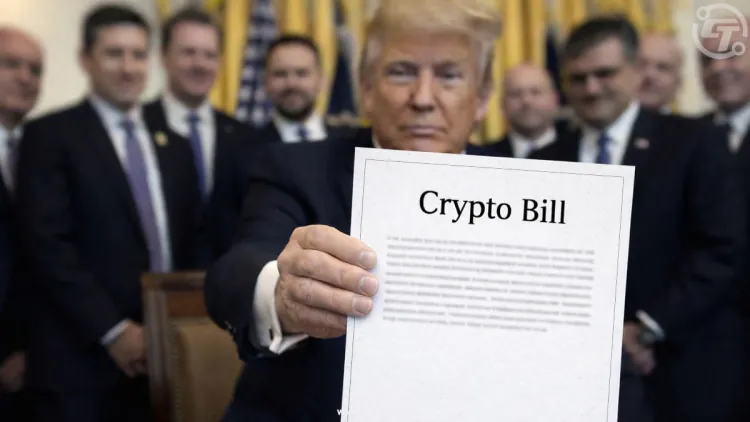
The digital asset sector is once more drawing major attention following statements from prominent U.S. political figures indicating strong progress toward broad cryptocurrency legislation. In recent commentary, a high-level adviser to former President Donald Trump remarked that enacting a crypto market structure law is no longer a question of “if” but “when” — a comment that may signal an important step forward in formalizing digital asset oversight across the United States.
This piece examines that statement, its likely effects on market behavior, participant trust, and the wider regulatory environment. We also tie these points to related coverage available on GetSetCrypto.com, spanning policy updates, analytical approaches, and essential blockchain concepts.
Why a Crypto Market Structure Bill Holds Significant Weight
During a recent Yahoo Finance discussion, a close Trump adviser stressed that the cryptocurrency space cannot remain largely outside formal regulation forever. The adviser highlighted growing agreement among policymakers that a dedicated crypto market structure law is needed — one that establishes legal classifications, supervisory rules, and structured guidelines for digital asset trading, much like existing frameworks for stocks and commodities.
This development carries importance for multiple reasons:
- Regulatory Clarity: Defined guidelines would allow trading venues, institutional allocators, and everyday users to better understand obligations and manage exposure.
- Investor Confidence: A structured legal foundation could lessen ambiguity related to storage, token listings, and marketplace operations.
- Market Infrastructure Development: Standardized processes for clearing, settlement, and transparency could support continued innovation and the creation of regulated financial instruments, including derivatives and asset tokenization.
Such clarity aligns with ongoing industry patterns and connects directly to the discussions featured in our crypto regulation & policy section.
Political Landscape: Banking Sector, Legislation, and Stakeholder Dynamics
Industry Resistance and Political Debate
Alongside the adviser’s remarks, Eric Trump publicly criticized leading U.S. banks, alleging they oppose crypto-focused legislation primarily to safeguard their own business models. He suggested that blockchain technology and digital markets represent a competitive challenge to conventional banking operations.
This exchange illustrates the multifaceted political environment surrounding digital asset governance:
- Traditional banks typically favor stable rules that preserve current financial systems.
- Crypto proponents maintain that outdated regulations hinder progress and capital formation.
- Legislators must navigate the balance between fostering advancement and ensuring consumer safeguards.
The final form of any market structure legislation will almost certainly reflect negotiations among these competing viewpoints.
Possible Effects on Bitcoin, Ethereum, and the Wider Market
Even in advance of enacted law, shifting regulatory expectations frequently influence trader psychology and asset valuations. Amid recent conditions, Bitcoin and Ethereum — foundational cryptocurrencies — have displayed notable price swings as participants process policy signals alongside broader economic factors. For additional perspective on these dynamics, see our analysis of Bitcoin price consolidation amid geopolitical tensions & ETF outflows.
How Regulation Influences Asset Valuations
Potential market structure legislation could affect leading cryptocurrencies in the following ways:
- Bitcoin (BTC): Greater legal predictability tends to draw institutional flows. When exchanges and custodians function under well-defined rules, interest from hedge funds, wealth advisors, and private offices often rises.
- Ethereum (ETH): As the backbone of decentralized finance, Ethereum stands to gain from frameworks that validate compliant DeFi and staking activities.
- Altcoins and newer tokens could see secondary benefits as overall market trust grows and risk discounts narrow.
These regulatory themes intersect closely with educational content on blockchain layers and consensus models — including differences between layer‑1 and layer‑2 blockchains and proof of stake vs proof of work.
The Path Forward for U.S. Crypto Market Structure Legislation
Timeline and Legislative Hurdles
Although the adviser views passage as inevitable, the exact schedule remains unclear. Any bill must navigate:
- Senate committee review and hearings
- Bipartisan negotiations
- Input from industry groups and potential revisions
Related proposals have previously encountered Senate delays, with critical deadlines extended into March — underscoring the challenge of reconciling innovation with prudent oversight. The digital asset community continues to advocate for rules that safeguard users while allowing technological development to flourish.
Regulatory Consequences for Different Market Participants
Exchanges and Trading Venues
More defined regulation could require:
- Enhanced transparency obligations
- Robust AML/KYC procedures
- Standardized custody and operational protocols
These measures would bring digital asset platforms closer to practices common in traditional finance.
Institutional Participants
Reduced legal ambiguity would likely encourage institutional allocation into:
- Spot and derivatives markets
- Tokenized real-world assets
- Professional custody services
Recent patterns show institutions already pursuing regulated entry points — a theme covered in our discussion of institutional adoption and market trends.
Retail Participants
Everyday investors stand to gain from:
- Stronger consumer safeguards
- Explicit definitions of prohibited conduct
- Uniform marketplace standards
Lower regulatory uncertainty typically correlates with broader retail participation.
Alignment with Worldwide Regulatory Patterns
While U.S. developments are central here, global jurisdictions continue advancing their own approaches. Nations such as Japan have provided legal clarity for assets like XRP and implemented licensing and compliance systems. Global policy trends are tracked in our coverage of crypto regulation policy global oversight.
These parallel efforts highlight a worldwide competition to attract crypto-related business through thoughtful regulatory design.
Current Market Mood and Policy Indicators
Present sentiment reflects cautious optimism:
- Participants closely monitor policy signals.
- Positive legislative news tends to ease uncertainty.
- Greater clarity could moderate short-term swings while supporting sustained investment.
Despite ongoing volatility, a broad industry consensus holds that well-designed, forward-looking regulation forms the foundation for lasting sector expansion.
For additional context on sentiment drivers and price action, explore the crypto education / market analysis resources.
Possible Drawbacks and Critiques of Increased Regulation
Although many support structured legislation, some concerns include:
- Excessive rules potentially hindering technological experimentation.
- Risk of regulatory capture benefiting established players over startups.
- International differences creating compliance challenges and arbitrage gaps.
These points emphasize the need for thoughtfully calibrated legislation that safeguards users while preserving room for innovation.
The Evolving Role of Crypto Service Providers
In preparation for more defined rules, wallet providers, custodians, and exchanges are proactively enhancing compliance programs and operational resilience.
These preparations align with topics in our blockchain info section, offering technical and ecosystem context on how infrastructure adapts to changing policy landscapes.
Conclusion
The recent assertion from a senior Trump adviser that crypto market structure legislation is only a matter of time serves as a meaningful marker for the digital asset industry. Anticipated regulatory clarity is welcomed by institutions, platforms, and retail users alike and holds potential to fundamentally alter how cryptocurrency markets function in the United States.
Though the path to enactment involves uncertainty, persistent congressional dialogue and industry support point toward eventual reform. When viewed alongside international regulatory progress, core blockchain advancements, and continuous market evaluation, these signals depict an industry steadily moving toward greater maturity.