Difference Between EVM and Non‑EVM Blockchains
Learn the key differences between EVM and non‑EVM blockchains, including how they execute smart contracts, languages used, interoperability, performance, developer ecosystem, and real‑world examples.
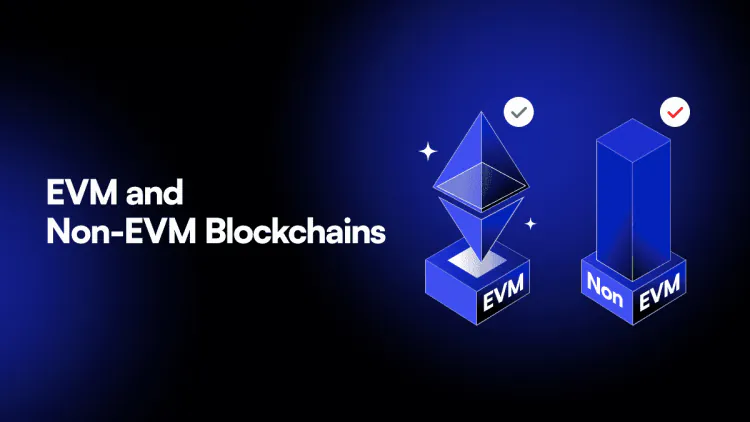
In the expanding blockchain landscape, EVM-compatible and non-EVM networks embody two fundamentally different philosophies for decentralized infrastructure. Grasping these distinctions empowers developers, investors, and end-users to select the most suitable platform for their projects and requirements.
An EVM chain operates using the Ethereum Virtual Machine—a uniform execution layer for smart contracts—whereas non-EVM chains adopt bespoke virtual machines and architectural designs tailored to specific goals. This piece delves into both categories, contrasts them across key criteria, and considers their prospective trajectories.
What Defines an EVM Blockchain?
The Ethereum Virtual Machine (EVM) functions as a decentralized computation engine that runs smart contracts on Ethereum and all compatible networks. It interprets standardized bytecode, enabling consistent behavior across distributed nodes. Developers typically write contracts in Solidity or Vyper, compile them to EVM bytecode, and deploy them for deterministic execution anywhere the EVM is supported.
Being Turing-complete, the EVM can theoretically handle any computational task (given sufficient gas), making it versatile for a wide range of decentralized applications. This standardization has fueled widespread adoption.
Prominent EVM-compatible networks include:
- Ethereum (the foundational EVM platform)
- BNB Smart Chain
- Polygon
- Avalanche C-Chain
- Arbitrum
- Optimism
EVM’s strength lies in its cross-chain compatibility and extensive developer community. A single contract can often be deployed—with little or no modification—across multiple chains, leveraging shared tooling, standards (e.g., ERC-20), and liquidity pools.
➤ Discover more about EVM ecosystems and their network advantages in crypto education / market analysis.
What Characterizes a Non-EVM Blockchain?
A non-EVM blockchain employs a custom execution environment or virtual machine that diverges from Ethereum’s design. These networks prioritize specialized performance, security models, or developer paradigms over compatibility with Ethereum tooling.
Notable non-EVM examples include:
- Solana (Sealevel VM)
- Cardano (Plutus)
- Cosmos (CosmWasm)
- Sui (Move VM)
- EOS (EOS VM)
Non-EVM platforms frequently emphasize high throughput, innovative consensus, or alternative programming languages (Rust, Move, etc.) instead of Solidity. While this freedom enables unique optimizations, it often means developers must rebuild tools and rewrite code when moving projects across ecosystems.
Key Comparisons: EVM vs Non-EVM Blockchains
The table below highlights the primary architectural, operational, and strategic differences:
| Feature | EVM Blockchains | Non-EVM Blockchains |
|---|---|---|
| Virtual Machine | Ethereum Virtual Machine | Custom (Sealevel, Plutus, CosmWasm, Move, etc.) |
| Smart Contract Languages | Solidity, Vyper | Rust, Go, OCaml, Move, etc. |
| Interoperability | High across EVM ecosystems | Limited natively; bridges often required |
| Tooling & Developer Ecosystem | Mature and extensive (MetaMask, Hardhat, Truffle, etc.) | Chain-specific; growing but more fragmented |
| Performance | Constrained by Ethereum base layer (improved via L2s) | Often engineered for higher TPS and lower latency |
| Security Model | Shared Ethereum heritage & tooling | Chain-specific; varies widely |
| Learning Curve | Lower for Solidity developers | Higher due to diverse languages and tooling |
| Migration Cost | Low across EVM networks | Higher; frequently requires code rewrites |
This comparison illustrates trade-offs in compatibility, performance, tooling maturity, and innovation freedom.
Execution Models and Programming Languages
EVM Execution Environment
The EVM delivers deterministic, gas-metered execution of bytecode across all compatible chains. This consistency allows developers to deploy once and operate across multiple networks with minimal adjustments. Solidity and Vyper remain the dominant languages, supported by a vast array of libraries, IDEs, and testing frameworks.
EVM compatibility resembles a universal runtime—like Java on different operating systems—enabling code portability and reducing deployment friction.
Non-EVM Execution Environments
Non-EVM networks implement custom VMs optimized for their goals. Examples include:
- Solana’s Sealevel VM enabling parallel transaction processing
- Cardano’s Plutus VM focused on formal verification and security
- Cosmos’ CosmWasm designed for modular, interoperable chains
These environments often support languages like Rust or Move, which prioritize memory safety or resource control, but require developers to learn new paradigms and toolchains.
Interoperability and Ecosystem Dynamics
EVM compatibility creates a flywheel effect: shared standards (ERC-20, ERC-721), unified wallets (MetaMask), and cross-chain bridges enable seamless asset and application movement. This fosters strong network effects—larger liquidity pools, more users, and greater developer mindshare.
Non-EVM chains may develop more specialized communities and use cases. While they sacrifice some immediate interoperability, they can pursue aggressive optimizations (e.g., ultra-high TPS) without EVM constraints, potentially carving out distinct market niches.
Scalability and Throughput
Performance remains a key differentiator:
- EVM chains inherit Ethereum’s base-layer limitations but increasingly rely on Layer-2 rollups, sidechains, and sharding to scale.
- Non-EVM chains frequently engineer native high-throughput designs—parallel execution, alternative consensus, or hardware optimizations—to achieve thousands of TPS at the L1 level.
Applications requiring ultra-low latency (gaming, high-frequency DeFi) may gravitate toward non-EVM platforms, while those prioritizing ecosystem breadth often remain EVM-aligned.
Security and Consensus Approaches
Both categories secure networks through diverse consensus mechanisms—PoS, PoH, Tendermint, etc. EVM chains typically inherit Ethereum-derived security models and benefit from extensive auditing and battle-testing. Non-EVM platforms may introduce novel consensus or economic designs that offer different decentralization or finality guarantees, accompanied by their own risk profiles.
Developer Adoption and Ecosystem Maturity
EVM’s early dominance has created a deep talent pool and standardized tooling. Solidity developers can rapidly prototype and deploy across multiple chains, leveraging shared infrastructure and libraries. This lowers barriers for new projects and accelerates iteration.
Non-EVM ecosystems attract developers interested in performance, novel languages, or specific architectural advantages. While tooling continues to improve, the learning curve and ecosystem fragmentation can slow initial adoption compared to EVM networks.
Use-Case Alignment: Choosing the Right Chain
Opt for EVM when:
- You need seamless cross-chain compatibility and access to established DeFi liquidity
- You value a mature, battle-tested developer toolkit
- You want to leverage existing standards (ERC-20, ERC-721, etc.)
Opt for Non-EVM when:
- You require native high throughput and low latency
- You want to explore innovative execution models or consensus designs
- You are comfortable with alternative languages and specialized tooling
Real-World Examples
EVM-Compatible Chains:
- Ethereum
- BNB Smart Chain
- Polygon
- Avalanche C-Chain
Non-EVM Chains:
- Solana
- Cosmos
- Cardano
- Sui
Conclusion
Both EVM and non-EVM architectures contribute vitally to blockchain’s diversity. EVM chains excel in ecosystem size, tooling maturity, and interoperability, while non-EVM chains push boundaries in performance, novel design, and specialization. The choice depends on priorities: broad compatibility and rapid deployment favor EVM, while maximum throughput or architectural freedom favor non-EVM approaches.
Stay informed on evolving blockchain trends through crypto news and blockchain info resources.
Sources
- EVM vs non-EVM architectural comparisons from various blockchain documentation and guides
- EVM ecosystem benefits and developer tooling overviews
- Non-EVM chain designs, VMs, and performance characteristics