Bitcoin Price Consolidation Amid Geopolitical Tensions and ETF Outflows
Bitcoin struggles to break above $90,000 as geopolitical uncertainty and ETF outflows weigh on market sentiment. Explore how real-time inflation data and institutional behavior impact price movements.

Bitcoin Holds Steady Under $90,000 as Uncertainty Persists
Bitcoin kicked off the week on a volatile note, slipping below the $90,000 mark after earlier speculation pointed toward a push beyond $100,000. Buyer enthusiasm has cooled, while sellers have refrained from heavy liquidation, trapping price action in a tight sideways pattern. This period of indecision reflects the ongoing influence of global events, large-player activity, and broader economic signals on Bitcoin’s valuation.
Internal link suggestion: For historical BTC trends, see Bitcoin Market Analysis.
Geopolitical Developments Weigh on Sentiment
Ongoing international friction has added to the cautious tone across digital asset markets. Former President Donald Trump recently outlined fresh tariffs aimed at nations opposing U.S. efforts to acquire Greenland, including a proposed 10% tariff layer. Concurrent delays in Supreme Court rulings on executive tariff powers have kept participants in a holding pattern.
Periods marked by policy ambiguity typically prompt investors to delay significant commitments, especially in high-beta instruments such as Bitcoin. Although crypto often responds most directly to U.S.-centric economic data, cross-border disputes can amplify hesitation, capping rallies and reinforcing range-bound trading.
Internal link suggestion: For geopolitical analysis impacting crypto, see Crypto News & Analysis.
ETF Redemptions Signal Institutional Restraint
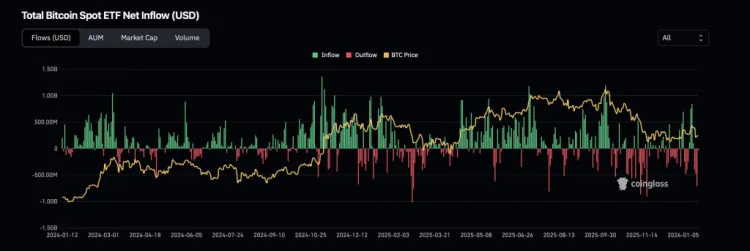
Institutional flows remain a pivotal driver of Bitcoin’s near-term stability. On January 21, spot Bitcoin ETFs saw roughly $709 million in net outflows—the heaviest single-day withdrawal since late November 2024 ($903 million). CoinGlass metrics reveal a clear preference among large allocators for preserving capital amid elevated uncertainty rather than increasing crypto allocations.
While grassroots enthusiasm may persist, the scale of institutional pullback suggests reluctance to build positions in the current environment. Repeated selling interest around the $98,000 zone indicates participants are capitalizing on brief upticks to reduce exposure or lock in profits, further anchoring price within a confined corridor.
Internal link suggestion: For ETF market insights, see Crypto ETFs Overview.
Internal link suggestion: For broader market indicators, see Crypto Market Trends.
Inflation Readings and Their Influence on BTC
Macroeconomic backdrop continues to shape Bitcoin’s trajectory. Alternative real-time inflation monitors currently place U.S. inflation around 1.2%—well under the headline 2.7% reading. These indices draw from vast daily transaction datasets covering e-commerce, energy costs, shelter, and consumer goods, providing a more immediate view of price pressures.
Despite the softer real-time signal, Bitcoin has stabilized close to $89,500. BTC’s historical pattern shows delayed reactions to inflation shifts, typically aligning more closely with evolving rate outlooks than spot CPI prints. Central banks and policymakers still anchor decisions to official statistics, contributing to the measured crypto market response.
Technical Picture: Sideways Trading Persists
Bitcoin is navigating an ascending price channel, finding temporary footing at the lower boundary earlier in the week. Nevertheless, advances have met consistent selling pressure, preventing a decisive breakout. Observers describe the structure as a mildly bearish consolidation, oscillating between key support near $81,100 and the average entry price of recent buyers.
Trading volume is subdued and directional conviction is limited, pointing to an ongoing wait-and-see stance. Market participants appear reluctant to commit aggressively until greater clarity emerges on interest-rate direction, geopolitical headlines, and economic data.
Internal link suggestion: For BTC technical analysis, see Bitcoin Technical Indicators.
Contrasting Institutional and Retail Dynamics
While ETF data points to institutional prudence, retail participants continue to provide a degree of underlying support. Smaller investors frequently target well-defined support/resistance zones, accumulating during perceived weakness and trimming near previous peaks. This interplay between cautious large capital and more opportunistic retail flow helps sustain the current range-bound environment.
Many alternative cryptocurrencies have faced deeper structural weakness, with liquidity rotating back toward Bitcoin and a handful of resilient names. This pattern reinforces Bitcoin’s status as a relative anchor within the broader digital asset space during times of elevated macro and geopolitical risk.
Internal link suggestion: For insights into altcoin performance, see Altcoins & Market Performance.
Bitcoin’s Typical Lag in Inflation Response
Bitcoin’s price tends to adjust to inflation signals with noticeable delay. Declining inflation readings generally foreshadow more accommodative financial conditions ahead, which can eventually favor risk assets. These shifts, however, unfold gradually—often requiring weeks or months to fully register in market pricing. Consequently, even with recent real-time inflation softness, Bitcoin has held firm around the $89,500 area.
Internal link suggestion: For macroeconomic analysis affecting crypto, see Crypto Economy Insights.
Current Market View & Core Observations
Geopolitical ambiguity, institutional outflows, and mixed inflation signals collectively point to a guarded near-term environment for Bitcoin. Principal takeaways include:
- Price Consolidation: BTC remains confined near $89,500, with buyers and sellers in relative equilibrium.
- Institutional Caution: Significant ETF redemptions reflect a defensive posture among major allocators.
- Geopolitical Impact: Tariff proposals and related legal delays foster broader market hesitation, indirectly constraining crypto liquidity.
- Inflation Influence: Real-time metrics show subdued pressure, yet Bitcoin’s response awaits clearer monetary-policy implications.
- Technical Support Levels: The lower boundary of the rising channel has provided defense, though overhead supply lingers near $91,200.
Together these elements depict a market in waiting mode, where both bullish and bearish impulses are restrained by prevailing caution and external variables.
Internal link suggestion: For historical BTC performance data, see Bitcoin Price History.
Closing Summary
Bitcoin’s present trading pattern illustrates the complex interplay of macroeconomic forces, institutional positioning, and technical structure. Although the cryptocurrency has yet to reclaim levels above $90,000, its behavior is shaped by several interconnected drivers:
- Geopolitical events introduce ongoing uncertainty.
- Institutional ETF outflows underscore selective risk aversion.
- Inflation data—both real-time and official—guide longer-term expectations.
- Technical barriers continue to define a constrained trading band.
Participants are advised to track these developments attentively. While conditions remain relatively contained at present, forthcoming policy updates, rate decisions, or shifts in global sentiment could spark renewed directional moves. A balanced understanding of both fundamental and technical contexts will remain essential for informed engagement with Bitcoin markets.
Internal link suggestion: For beginner and advanced trading strategies, see Crypto Education.