What Is USOR Crypto?
Learn what USOR crypto is, how the United States Oil Reserve (USOR) token works, its features, risks, and use cases, and how it connects blockchain technology with oil market transparency in 2026.
In 2026, global energy markets continue to experience uncertainty driven by geopolitical tensions, supply disruptions, and shifting economic policies. These factors have increased volatility in oil prices, encouraging investors and researchers to explore alternative, technology-driven approaches to commodity exposure.
One emerging concept is the use of blockchain technology to improve transparency and accessibility in commodity-related markets. United States Oil Reserve (USOR) is a crypto project that aims to apply this idea by publishing oil-related reserve data and token activity on-chain using the Solana blockchain.
This guide explains what USOR crypto is, how it works, its key features, potential benefits, and important risks to consider.
What Is USOR Crypto?
USOR (United States Oil Reserve) is a Solana-based (SPL) digital token designed to place oil reserve-related information on the blockchain for public verification. The project focuses on transparency by making token supply data, reserve wallet balances, and transaction activity visible through on-chain records.
Unlike traditional oil investments such as futures contracts, ETFs, or physical commodities, USOR operates in a decentralized environment. This allows global access, continuous trading, and blockchain-based recordkeeping.
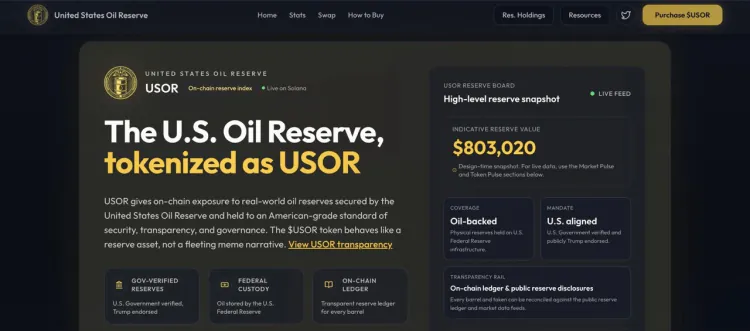
According to information published on the project’s official website, https://www.usortech.com/ USOR aims to provide verifiable reserve data using blockchain technology. It is important to note that USOR is not affiliated with the U.S. government or the Strategic Petroleum Reserve and operates independently.
Key Features of United States Oil Reserve (USOR)
Built on Solana
USOR uses the Solana blockchain, which is known for high transaction speeds and low network fees compared to many legacy blockchain systems.
On-Chain Transparency
All token issuance, reserve wallet balances, and transaction activity are recorded on the public blockchain. This allows users to independently verify key data without relying solely on centralized reports.
Fixed Token Supply
The total supply of USOR tokens is capped at 1 billion, with no additional tokens planned. This fixed supply model provides predictable token economics.
Reserve Representation Concept
USOR’s stated goal is to digitally represent oil reserve-related data on-chain, offering what the project describes as blockchain-based reserve visibility.
Auditable Structure
Because data is published on-chain, community members and third-party reviewers can monitor supply, holdings, and transactions at any time.
How Does USOR Crypto Work?
Tokenization and Data Visibility
USOR does not grant ownership of physical oil. Instead, it focuses on publishing reserve-related information and token metrics on the blockchain. This approach allows users to view supply data, reserve wallet activity, and transaction history through public blockchain explorers.
Public Metrics
As of early 2026, commonly published data includes:
-
Total and circulating token supply
-
Reserve wallet balances
-
Liquidity information
-
Transaction activity and holder distribution
These metrics are updated regularly and are accessible through the project’s official dashboard and on-chain tools.
USOR Tokenomics Overview
-
Token Name: United States Oil Reserve (USOR)
-
Blockchain: Solana (SPL standard)
-
Total Supply: 1,000,000,000 USOR
-
Utility: Trading, transparency, and potential future ecosystem features
-
Audit Model: Community and third-party verification
How to Buy USOR Crypto
USOR tokens are generally available through supported on-chain trading platforms and decentralized exchanges within the Solana ecosystem. Users should always confirm official contract addresses using trusted sources before interacting with any token.
For individuals seeking traditional oil exposure, some platforms also offer oil-related trading pairs that are separate from USOR and operate under conventional financial systems.
Potential Advantages and Use Cases
Decentralized Access
USOR allows participation without traditional commodity brokers or futures contracts.
Blockchain Transparency
All transactions and supply data are publicly verifiable, reducing information asymmetry.
DeFi Compatibility
As a Solana-based token, USOR may integrate with decentralized finance applications such as liquidity pools or lending platforms.
24/7 Global Availability
USOR can be transferred and traded at any time, without geographic restrictions.
Is USOR Legit? Key Considerations
Before engaging with USOR, users should understand the following:
-
No Government Backing: USOR is not managed or guaranteed by any government entity.
-
Market Volatility: Prices may fluctuate due to crypto market conditions and oil-related sentiment.
-
Audit Dependence: Transparency depends on accurate reporting and reliable audits.
-
Regulatory Uncertainty: Future regulations could affect accessibility or compliance requirements.
Conclusion
The United States Oil Reserve (USOR) token represents an experimental approach to combining blockchain technology with oil-related market concepts. By using Solana’s infrastructure, the project aims to provide fast transactions, low fees, and publicly verifiable reserve data.
While USOR introduces innovative ideas around transparency and decentralized access, it also carries risks common to both crypto assets and commodity-linked projects. Careful research, independent verification, and ongoing monitoring are essential before interacting with USOR or similar tokens.